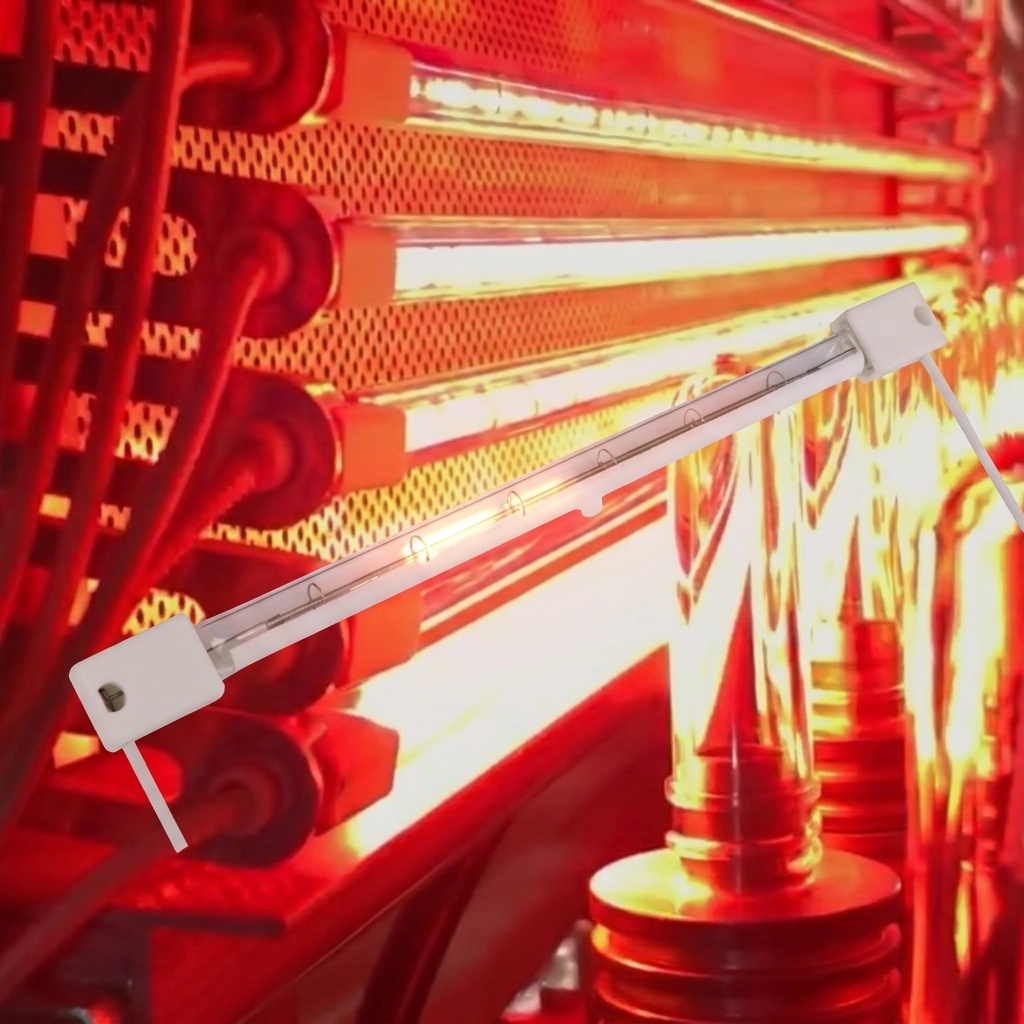
Clear vs Reflector Lamps in PET Reheating: What to Compare
In PET preform reheat ovens, plant teams frequently debate whether to equip their heating cassettes with standard clear quartz lamps or upgrade to lamps with an integral reflective coating (such as ceramic white or gold). Sales literature often claims that switching to reflector lamps delivers “instant 30% energy savings.” In reality, coating reflectance, forward radiant flux, and whole-machine energy consumption are governed by distinct thermodynamic mechanisms. Deciding between clear and reflector lamps requires evaluating the physical design of your oven cavity, maintenance practices, and mounting constraints.
1. Physical Construction and Optical Directivity
The fundamental difference between clear and reflector emitters lies in how radiation is emitted from the quartz envelope:
[CLEAR QUARTZ LAMP (360° Omnidirectional)]      [INTEGRAL REFLECTOR LAMP (180° Directional)]
             ↑                                                ↑
         ← ( O ) →                                        ← ( O | White Ceramic Layer
             ↓                                                ↓
(Requires external oven back-mirror)            (Redirects >85% radiant flux forward)
- Clear Quartz Lamps (e.g., Goldisgood GIG-010 Series): The quartz glass envelope is completely transparent around its full $360^\circ$ circumference. Radiant flux emits isotropically in all radial directions. The 50% of radiant energy directed backward away from the preforms relies entirely on external oven mirrors (polished aluminum or stainless steel panels) to bounce back toward the preform path.
- Integral Ceramic White Reflector (e.g., Goldisgood GIG-011 Series): The rear $180^\circ$ hemisphere of the quartz tube is coated with a high-purity, diffuse-reflective ceramic oxide layer ($ZrO_2$ / $Al_2O_3$) sintered onto the glass at high temperatures. The coating diffusely redirects approximately 85% to 90% of backward-traveling infrared rays forward into the preform target zone.
- Integral Gold Mirror Reflector: A thin layer of pure gold ($Au$) is sputtered or chemically deposited onto the rear hemisphere. Gold acts as a specular (mirror-like) reflector with $>95%$ infrared reflectance in the short-wave and near-infrared bands.
2. Comparing Optical Performance and Cavity Dynamics
| Evaluation Factor | Clear Quartz Lamp | Ceramic White Reflector | Gold Reflector |
|---|---|---|---|
| Directivity | Omnidirectional ($360^\circ$) | Forward directional ($180^\circ$ primary lobe) | Forward directional ($180^\circ$ specular) |
| Coating Reflectance | N/A (Relies on external mirror) | $\sim 85%\text{–}90%$ diffuse | $>95%$ specular |
| Max Tube Temp Tolerance | $>1000^\circ\text{C}$ | $>900^\circ\text{C}$ (Highly stable) | $\sim 600^\circ\text{C}$ (Gold degrades if overheated) |
| Sensitivity to Oven Mirror Degradation | Extremely high (Drop in mirror cleanliness directly cuts preform heat) | Low (Reflector is renewed with every lamp replacement) | Low (Integral mirror is protected) |
| Unit Lamp Cost | Lowest baseline | Moderate ($+15%\text{–}25%$) | Higher ($+30%\text{–}50%$) |
3. Dissecting the “Energy Savings” Claim: Coating vs. System
A crucial distinction must be maintained:coating reflectance is not equivalent to machine energy savings.
- **Path Losses:**While a gold coating reflects 95% of rearward photons, some of that reflected energy passes back through the filament and the front quartz wall, suffering absorption and re-radiation losses.
- **Cavity Geometry:**If a blow moulding oven already features pristine, water-cooled parabolic aluminum mirrors that are cleaned weekly, the net efficiency gain of switching to an integral white reflector lamp may only be 5% to 8% in electrical draw.
- **Degraded Cavity Reality:**However, in real-world packaging plants where oven back-mirrors are clouded with dust, oil vapors, and oxidation (dropping mirror reflectivity below 50%), installing integral ceramic reflector lamps restores forward radiant intensity dramatically, often allowing operators to drop oven zone setpoints by 10% to 15%.
4. Mechanical and Installation Constraints
When installing reflector lamps, proper orientation is vital:
- **Rotational Orientation:**An integral reflector lamp must be installed with the coated hemisphere facing directly away from the preforms (pointing toward the back of the oven cassette). If a maintenance technician installs a reflector lamp backward, the radiant flux directed toward the preform is virtually zero, causing total zone collapse.
- **Base Keying (SK15 Bases):**Most reflector lamps designed for blow moulding utilize keyed ceramic end caps (such as SK15 flat slots) that physically prevent the lamp from twisting inside the socket bracket, guaranteeing correct forward alignment.
- **Thermal Dissipation:**Integral coatings trap a portion of heat within the rear quartz wall. Adequate ventilation airflow across the back of the lamp cassette is essential to avoid overheating the quartz envelope or accelerating pinch seal degradation.
5. Decision Framework: When to Choose Which Lamp Style
Plant engineering teams should select lamp configurations based on operational discipline:
[Is the oven cassette designed with precision, water-cooled external mirrors?]
      │
      ├──> YES: Are mirror panels cleaned and inspected on a strict PM schedule?
      │           ├──> YES: Clear Quartz Lamps (GIG-010) offer maximum economy and high performance.
      │           └──> NO:  Upgrade to White Reflector Lamps (GIG-011) to eliminate dependence on dirty mirrors.
      │
      └──> NO:  (Open cassette or flat sheet-metal cavity)
                  └──> White Reflector Lamps (GIG-011) are mandatory to direct radiant energy efficiently.
Related Guides
- How to Specify a Replacement PET Preform Heating Lamp
- Overall Length vs Heated Length in PET Infrared Lamps
- How to Compare PET Reheating Energy per Accepted Bottle
Related Goldisgood Heating Solutions & Optical Evaluation
Whether your oven cavity requires omnidirectional radiation or high-directivity integral reflection, Goldisgood manufactures both configurations to rigorous standards:
- **Clear Quartz Emitters (GIG-010 Series):**Cost-effective 360° emitters for blow moulders equipped with well-maintained external parabolic mirrors. View Specifications on Goldisgood
- **Integral White Ceramic Reflector Emitters (GIG-011 Series):**Diffuse 180° ceramic oxide coating redirects up to 90% of radiant flux forward, making ovens independent of tarnished external mirrors. View Specifications on Goldisgood
- **Comparative Trial Support:**Request sample lamps for side-by-side electrical and thermal efficiency trials by contacting our technical team at
info@goldisgood.com.
Sources & References
- Optical Society of America (OSA) / Applied Optics: Directional Reflectance and Thermal Stability of Sintered Ceramic Oxide Coatings in Radiant Heating.
- National Physical Laboratory (NPL): Measurement of Spectral Hemispherical Reflectance of Thermal Radiation Coatings.
- Society of Plastics Engineers (SPE) Technical Papers: Comparative Radiant Energy Transfer in Oven Cavities with Integral vs. External Reflectors.
- Goldisgood Product Engineering: Comparative Optical Specifications: GIG-010 Clear vs. GIG-011 Ceramic Reflector Lamps.