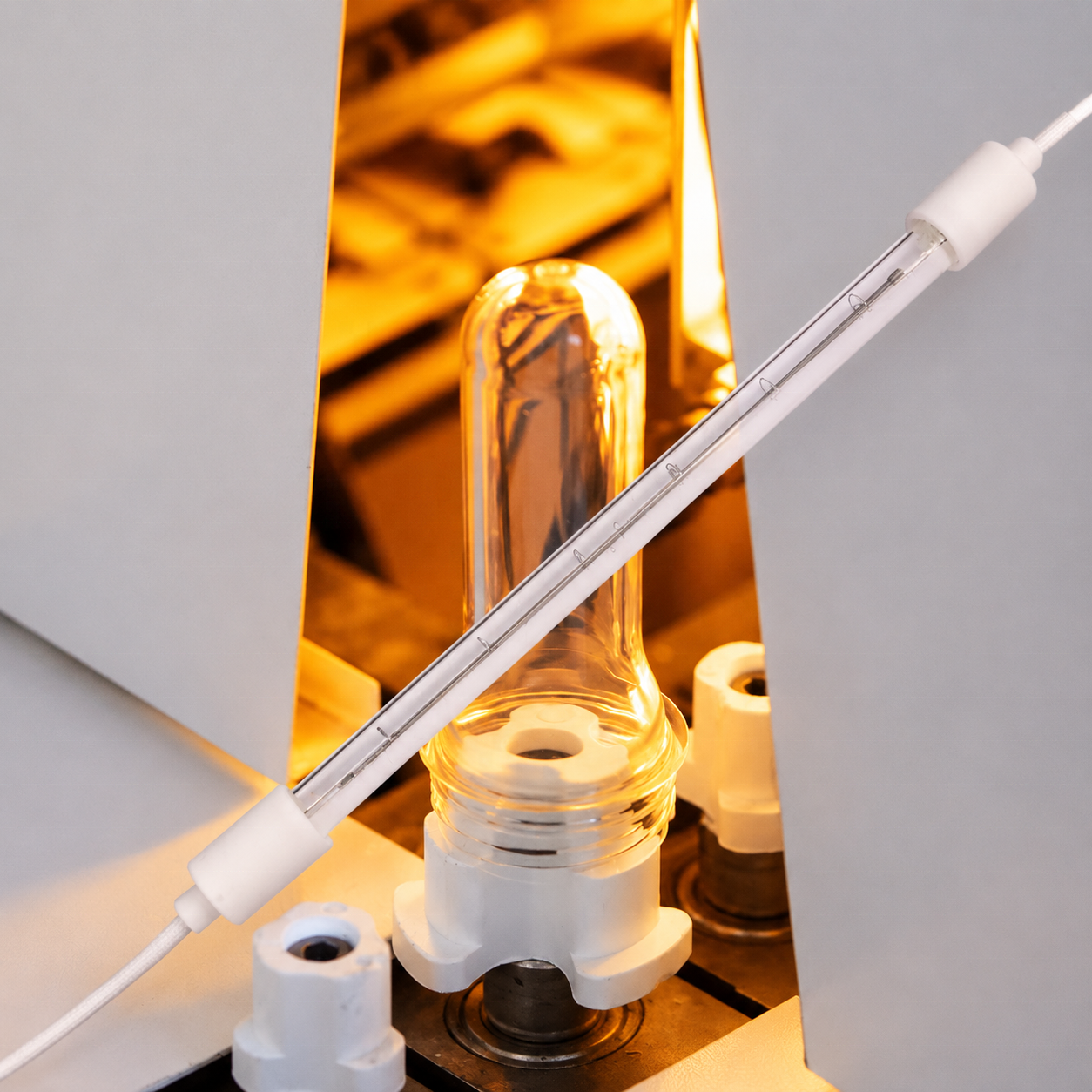
Laser vs Halogen PET Preform Reheating: What Plant Teams Should Compare
For more than four decades, quartz tungsten-halogen infrared lamps have served as the undisputed workhorse of PET stretch blow moulding ovens. Recently, commercial announcements of industrial laser preform reheating—such as industrial laser preform reheating deployments announced in the beverage packaging industry in early 2026—have sparked intense debate among plant engineering teams. Proponents highlight dramatic reductions in oven footprint, elimination of preform rotation, and direct electrical-to-thermal conversion efficiency. However, converting these technological promises into a sound plant decision requires separating marketing enthusiasm from thermodynamic reality. Industrial packaging teams must evaluate laser reheating against established quartz halogen technology across physical, operational, and financial dimensions.
1. Thermodynamic and Optical Principles Compared
The fundamental physics governing how energy transfers into the polymer differs fundamentally between broadband halogen radiation and monochromatic laser beams:
[CONVENTIONAL QUARTZ HALOGEN EMITTER]
  - Broad continuous blackbody spectrum (Peak ~1.0 - 1.4 µm).
  - Radiates 360° (or 180° with integral reflector).
  - Volumetric absorption: Shorter wavelengths penetrate wall, longer wavelengths absorb near skin.
  - Requires continuous 360° spindle rotation to achieve circumferential uniformity.
[INDUSTRIAL DIRECT-DIODE LASER SYSTEM]
  - Narrow, monochromatic emission tuned specifically to a chosen PET molecular absorption band.
  - Highly collimated, coherent beam directed with precision optics.
  - Direct volumetric penetration with zero peripheral scatter.
  - Elimination of preform rotation: Multi-beam profiling heats both sides symmetrically.
2. Multi-Factor Engineering Comparison
To provide a defensible foundation for technical evaluation, the operational differences between both technologies are summarized below:
| Evaluation Dimension | Quartz Tungsten-Halogen IR Lamps | Direct-Diode Industrial Laser Reheating |
|---|---|---|
| Optical Spectrum | Continuous broad-band ($0.8\text{–}3.0\ \mu\text{m}$, peak $\sim 1.2\ \mu\text{m}$) | Monochromatic narrow-band tuned to specific absorption peak |
| Mechanical Handling | Requires rotating mandrels, drive belts, and bearings | Preforms travel linearly without rotation; simplified conveyor |
| Footprint & Tunnel Length | Extended oven tunnel ($15\text{–}30\ \text{m}$ chain loop) | Compact footprint (up to 40%–50% reduction in oven length) |
| Start-Up Time & Thermal Inertia | Emitters reach output in 1–2 sec; cavity requires 5–10 min thermal equilibration | Instantaneous on/off optical response ($<0.1\ \text{sec}$); zero cavity warmup |
| Electrical-to-Polymer Efficiency | $\sim 30%\text{–}45%$ of gross electricity absorbed into preform (rest lost to convection/scatter) | Claimed $>55%\text{–}65%$ direct optical coupling into preform matrix |
| Safety & Enclosure | Standard machine guarding and thermal insulation | Class 4 laser safety containment; interlocked light-tight enclosures |
| Capital Expenditure (Capex) | Very low capital cost; standardized componentry | High initial capital cost (specialized diode bars, chillers, and beam optics) |
| Spares & Field Replaceability | Immediate plant technician replacement in $<5\ \text{minutes}$ per lamp | Specialized service; optical cleaning cleanroom requirements |
3. Dissecting the Operational Tradeoffs
Energy Efficiency and Heat Sinking
Halogen lamps emit broad-spectrum radiation. Because only a portion of the broad spectrum matches PET’s natural absorption bands, substantial radiant energy passes unabsorbed through the preform into the back-reflectors or convective oven air, requiring large cooling blowers and exhaust dampers. Laser diodes, by contrast, emit almost entirely at a selected resonant wavelength, ensuring a higher percentage of emitted photons are captured within the resin wall. However, laser diodes themselves are only 45%–55% electrically efficient, requiring dedicated deionized water chillers to remove substantial waste heat generated at the diode junction. When evaluating total line power, plants must measuretotal system power including the laser chiller, not just diode beam power.
Mechanical Simplicity vs. Optical Complexity
By directing laser energy symmetrically, laser ovens eliminate the rotating mandrel belt, spindle drive gears, and associated high-temperature bearings. This eliminates circumferential temperature variations caused by slipping belts. However, mechanical simplicity is traded for optical complexity. Laser beam homogenizers, collimating lenses, and protective optical windows must remain impeccably clean. A microscopic layer of dust, airborne oil vapor, or PET oligomer haze deposited onto a laser window will absorb laser energy, overheat, and crack expensive optical quartz elements.
Retrofit Reality vs. Green-Field Installations
- Halogen Lamp Retrofits: Upgrading an existing oven with high-efficiency quartz lamps (e.g., Goldisgood GIG-011 white reflector lamps), modern SCR controllers, or optimized ventilation blowers is an economical project with payback measured in months. Any plant technician can install and maintain the hardware.
- Laser Systems: Laser reheating is currently sold primarily as integrated hardware on new green-field rotary machines. Retrofitting an existing legacy blow moulder with a laser module is rarely financially viable due to machine chassis, electrical bus, and safety containment rebuild requirements.
4. What Plant Teams Should Request Before Making a Decision
Before committing capital to either an advanced halogen overhaul or a new laser-equipped machine, request the following data from machinery vendors:
+ -------------------------------------------------------------------------------+
| TECHNICAL DUE DILIGENCE CHECKLIST FOR HEATING TECHNOLOGY EVALUATION           |
+ -------------------------------------------------------------------------------+
1. [Total Line Specific Energy]:
   - Request true measured kWh per 1,000 accepted bottles, INCLUDING all auxiliary
     chillers, exhaust fans, and compressor loads during continuous 24-hour running.
2. [Resin Flexibility & rPET Range]:
   - How does the system handle rapid transitions between clear virgin PET and 100%
     dark rPET? (Does the laser wavelength require optical re-tuning for darker resins?)
3. [Diode Stack Service Life & Replacement Cost]:
   - What is the Mean Time Between Failures (MTBF) of the laser diode modules?
   - What is the replacement cost and lead time for a replacement diode bar vs. a
     standard quartz infrared lamp?
4. [Optical Maintenance Protocol]:
   - What cleanroom or field procedures are required to clean laser protective windows?
   - What diagnostic sensors detect optical fouling before glass failure occurs?
+ -------------------------------------------------------------------------------+
5. Summary Conclusion
Laser reheating represents a genuine technological advancement in PET packaging, proving that focused optical physics can compress oven footprints and eliminate mechanical rotation. For high-volume, single-format production plants with high electricity tariffs, laser technology will increasingly justify its capital premium. However, for the vast majority of packaging converters running diverse container formats, varied rPET grades, and existing machine fleets,high-performance quartz halogen lamps remain the industry benchmark—offering unbeatable maintenance simplicity, broad resin tolerance, and robust capital economy.
Related Guides
- How to Compare PET Reheating Energy per Accepted Bottle
- rPET Preform Reheating: What to Review When Material Batches Change
- How Infrared Heating Works in PET Preform Reheating
Related Goldisgood Heating Solutions & Lifecycle Cost Management
For plant teams seeking the optimal balance between high thermal efficiency, low capital expenditure, and straightforward maintenance:
- **Industrial Quartz Halogen Emitters (GIG-010 & GIG-011 Series):**The industry standard for robust, cost-effective preform reheating, offering immediate field serviceability and universal resin tolerance. View Specifications on Goldisgood
- **Oven Modernization Upgrades:**Replace aging emitters with integral white ceramic reflector lamps to achieve immediate efficiency gains without capital-intensive line replacements.
- **Strategic Sourcing Consultation:**Contact Goldisgood at
info@goldisgood.comor visit Goldisgood to review plant spare-parts agreements and oven cassette retrofit kits.
Sources & References
- Fraunhofer Institute for Laser Technology (ILT): Monochromatic Diode Laser Heating of Semi-Crystalline Thermoplastics.
- Journal of Laser Applications / Laser Institute of America (LIA): Comparative Optical Coupling Efficiency: Broad-Band Infrared Emitters vs. Diode Lasers.
- Society of Plastics Engineers (SPE) ANTEC Proceedings: Energy Balance and Economic Feasibility of Laser-Assisted Stretch Blow Molding.
- Goldisgood Engineering Analysis: Comparative Lifecycle Cost and Reliability: Quartz Halogen Emitters vs. Direct-Diode Laser Systems.