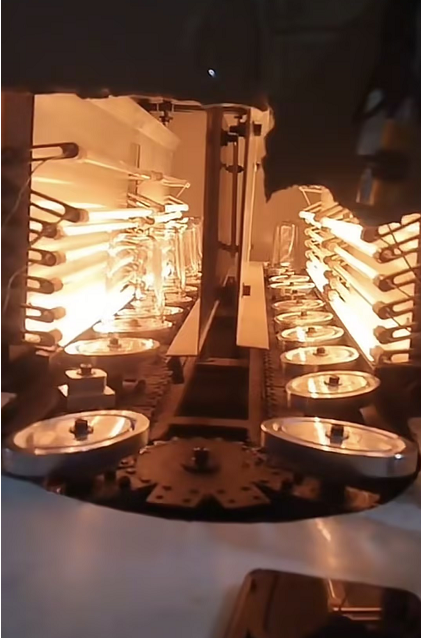
Uneven PET Preform Heating: What to Check
When blow moulding operators detect container wall thickness variations, hazy patches, or off-center bases, the initial reaction is often to blame an infrared heating lamp or hastily crank up oven zone setpoints. In reality, uneven preform heating stems from multiple interrelated sources: mechanical transport errors, optical reflector fouling, cooling airflow turbulence, or raw material batch variations. A systematic diagnostic procedure begins by categorizing the thermal variation pattern before touching any machine settings.
1. Classify the Pattern: Circumferential vs. Axial vs. Temporal
Observing where and how temperature deviates reveals the underlying physical failure mode:
+ -----------------------------------------------------------------------------------------+
|                                UNEVEN HEATING PATTERNS                                  |
+ -----------------------------------------------------------------------------------------+
       │
       ├──> [Circumferential Variation (Around the Perimeter)]
       │      └──> One side hot, opposite side cold. Cause: Rotation failure, spindle slip.
       │
       ├──> [Axial Variation (Top to Bottom)]
       │      └──> Neck too hot, base too cold. Cause: Zone recipe error, lamp burnout, misalignment.
       │
       └──> [Temporal / Batch Variation (Over Time)]
              └──> Temperature drifts across shifts. Cause: Voltage fluctuation, rPET shift, drafts.
- Circumferential Inconsistency: The preform temperature varies around its perimeter at the same vertical height. If the delta between the hottest and coldest quadrant exceeds $3^\circ\text{C}\text{–}4^\circ\text{C}$, the blown bottle will inevitably exhibit uneven radial wall thickness or axial bowing (banana bottles).
- Axial (Vertical) Distortion: The vertical temperature profile along the preform axis deviates from the qualified curve, pushing material either too close to the shoulder or pooling excessive weight at the base.
- Batch-to-Batch or Shift Drift: Preforms leaving the oven show cyclic shifts in average temperature across different hours of the day or when loading a new preform gaylord.
2. Check Mandrel Rotation and Conveyor Mechanics
Circumferential thermal variation is almost exclusively a mechanical transport defect rather than an electrical lamp problem:
- **Spindle Drive Belts:**Inspect the continuous rotation belt that spins the preform mandrels as they travel past the lamps. Look for loose belt tension, oil contamination on the belt track, or worn drive teeth that cause intermittent slipping.
- **Mandrel Bearing Seizure:**Manually spin individual mandrels on the conveyor chain when the oven is cold. Mandrels that stick, grind, or bind due to heat-degraded bearing grease will stall inside the oven, causing severe single-sided scorching.
- **Chain Pitch Vibration:**Excessive conveyor chain slack causes preforms to wobble or vibrate erratically as they pass close to emitter quartz envelopes, producing uneven radiant flux exposure.
3. Inspect Infrared Emitters and Optical Reflectors
If temperature anomalies follow an axial (vertical) pattern or correspond to specific lamp heights, examine the emitter array:
| Component | What to Inspect | Observable Impact |
|---|---|---|
| Emitter Lamps | Check for unlit lamps, blackened quartz tubes, or sagging filament coils | Complete loss of heat in one vertical tier, forcing adjacent zones to overcompensate |
| Lamp Alignment & Tilt | Verify that all lamps sit perfectly parallel to the preform travel plane | Distorted radiant focus; localized hot spots on preform shoulders |
| Ceramic / Gold Reflectors | Inspect integral coatings for peeling, flaking, or thermal discoloration | Loss of directional radiant efficiency; erratic scatter |
| Oven Back-Mirrors | Check aluminum or stainless reflector panels for dust, oil film, or oxidation | Reflectivity drops from $>90%$ to $<60%$, reducing radiant energy reaching the shadowed side |
- Maintenance Tip:* Never touch quartz lamp envelopes with bare hands. Fingerprint oils bake into the quartz at high operating temperatures, causing permanent devitrification (milky white clouding) and localized quartz failure.
4. Evaluate Cooling Airflow and Ventilation Balance
Ventilation air inside the oven is just as critical as radiant heat. If airflow is imbalanced, thermal uniformity collapses:
- Blower Filters and Inlets: Clogged intake air filters starve the oven of cooling air. This causes preform surface temperatures to spike rapidly, creating surface haze before the inner wall reaches stretch temperature.
- Exhaust Chimney Balance: Preform ovens require an exhaust damper to vent warm convective air. If exhaust dampers are closed or exhaust fan motors fail, heat builds up uncontrollably at the top of the oven, overheating preform neck finishes.
- External Factory Drafts: Ensure that blow moulder enclosure doors remain tightly latched. Uncontrolled drafts from nearby warehouse loading docks or HVAC vents disturb the air boundary layer inside the oven tunnel.
5. Account for Preform Resin and Dimensional Shifts
Not all heating irregularities originate inside the oven. Incoming preform variations directly alter thermal absorption:
- **Preform Storage Temperature:**Processing preforms brought directly from an unheated winter warehouse will result in under-heated cores if the oven recipe was qualified at $25^\circ\text{C}$ ambient. Allow preforms to equilibrate to factory ambient for at least 24 hours.
- **rPET and Color Additives:**Recycled PET (rPET) resin and carbon black/toner additives significantly increase infrared absorption. A batch of preforms with higher rPET content or darker hue will heat noticeably faster under identical lamp settings, necessitating a downward power adjustment.
- **Wall Thickness Eccentricity:**Preforms with injection core shift have uneven wall thickness around their circumference. Thinner walls heat much faster than thicker walls, producing an apparent heating imbalance that is actually an injection moulding defect.
6. Structured Diagnostic Checklist and Escalation
Before escalating to component replacement, work through this four-step diagnostic sequence:
[Step 1: Visual & Mechanical Audit]
 - Confirm all lamps are glowing uniformly.
 - Verify free 360° rotation of all spindles across the entire chain track.
 - Check neck shield alignment and clear clearance.
[Step 2: Temperature Measurement]
 - Use a high-speed IR pyrometer to measure top, middle, and bottom preform temperatures.
 - Record circumferential variation by measuring 4 quadrants at 90° intervals.
[Step 3: Controlled Single-Variable Isolation]
 - Clean all oven back-reflectors and wipe quartz lamps with isopropanol (oven cold!).
 - Verify line voltage stability at the main power distribution bus.
[Step 4: Quality Escalation]
 - If one tier remains cold despite 100% setpoint, test SCR/SSR output voltage with a true-RMS meter.
 - Replace suspected aged or degraded emitters with verified specification lamps (e.g., Goldisgood GIG-010).
Related Guides
- PET Preform Temperature Measurement: What to Measure and Record
- Uneven PET Bottle Wall Thickness: Heating and Process Factors
- PET Preform Heating Zones Explained
Related Goldisgood Heating Solutions & Troubleshooting Assistance
When diagnosing heating inconsistencies or resolving lamp bank performance issues, plant engineers can rely on Goldisgood technical support:
- **Verified Replacement Quartz Emitters (GIG-010 / GIG-011):**Manufactured with high-purity quartz envelopes and stabilized tungsten coils to eliminate premature resistance drift. View Specifications on Goldisgood
- **Reflector Upgrades:**Upgrade legacy open cassettes with half-coated white ceramic reflector lamps to stabilize forward radiation. View Product Details
- **Root-Cause Diagnostic Support:**Contact Goldisgood technical engineering at
info@goldisgood.comwith your preform temperature profiles and lamp electrical readings for troubleshooting guidance.
Sources & References
- Society of Plastics Engineers (SPE) Blow Molding Division: Diagnostic Guide for Processing and Thermal Variations in PET Stretch Blow Moulding.
- National Institute of Standards and Technology (NIST): Guide for Industrial Thermometry and Thermal Uniformity Surveys in Radiant Ovens.
- Journal of Applied Polymer Science: Investigation of Circumferential Temperature Gradients on Wall Uniformity in Blow Molded PET.
- Goldisgood Engineering Standard: Infrared Lamp Performance and Field Diagnostic Criteria.